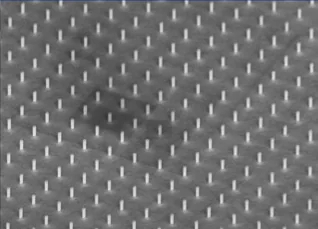
Direct-write fabrication of devices and structures, by its nature, is carried out in a serial manner and, as such, is not conducive to the mass production of devices. However, the use of imprinting techniques, which can replicate structures quickly and cheaply, is beginning to show promise. The use of direct writing to fabricate stamps and molds that can be used as imprinting masters therefore offers the possibility of fabricating structures that may be commercially competitive with those produced by masked processes. P-beam writing, which is able to produce structures with vertical and smooth sidewalls in resist material, is an ideal technique for fabricating three-dimensional structures suitable for molds and stamps. The p-beam written structures can be subsequently transformed into metal negatives using electroplating techniques, and the quality and reproducibility of the stamps are excellent [1,2].
References
- Ansari, K., et al., Nucl. Instr. Meth. Phys. Res. B (2005) 231, 407
- Ansari, K., et al., J. Micromech. Microeng. (2006) 16, 1967